If you have ever watched a film with subtitles and thought, “I would have translated that differently,” you are most probably not alone. Subtitling is one of those jobs that looks deceptively easy from the outside.
After all, the audience only sees two lines of text at the bottom of the screen. How hard can it be?
As it turns out, quite hard. Here’s why.
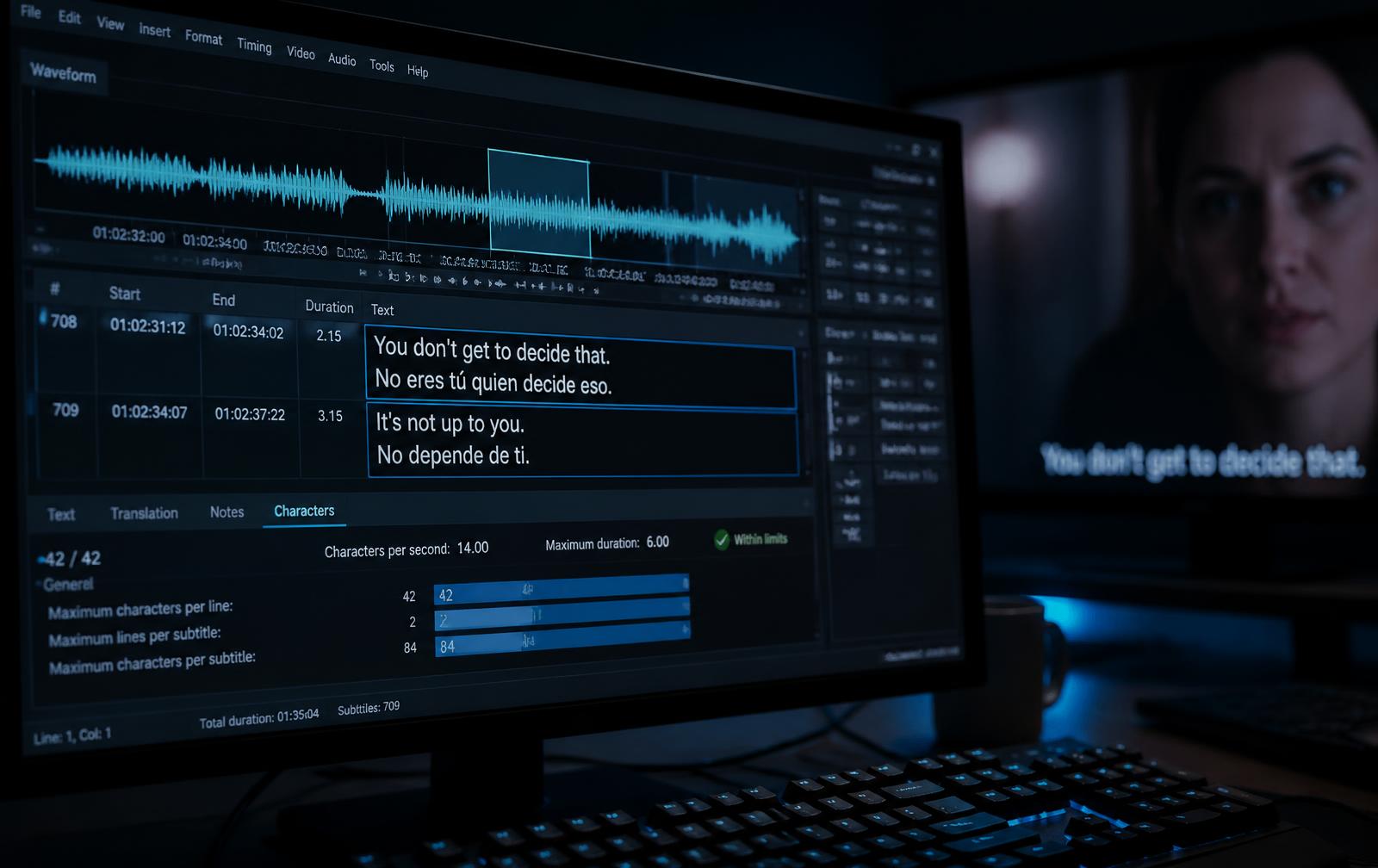
Most viewers have no idea that professional subtitling is largely influenced by a strict set of technical constraints. The industry-wide standard is set at around 42 characters per line, a maximum of two lines on screen throughout the film, and a reading speed that shouldn’t exceed 17 characters per second. These standards are designed to ensure that the average viewer will be able to comfortably read the subtitles and still follow the on-screen action.
Then comes timing. Each and every subtitle has to start and end at a precise point which is aligned with the pace of the speech as well as the cuts in the edit. If a subtitle lingers too long, it simply feels lazy; if it disappears too fast, the viewer might not be able to read it in time. And when a character speaks quickly, or two characters talk over each other, or a scene cuts mid-sentence – the subtitler has to make a call. Something gets condensed, restructured, or occasionally left out entirely. Not because the translator missed it, but because the rulebook demanded a choice.
It is sometimes better to leave out exclamations like “hey” and “come on” for the sake of getting the essential message across. A quick example shows how this works in practice. Take a line such as:
“Hey! Come on, man, you’ve got to be kidding me!”
In a subtitle, that might simply become:
“You’ve got to be kidding.”
The exclamations disappear, not because they were misunderstood or forgotten, but because they add little to the meaning while taking up valuable space and reading time. The meaning of the line is still conveyed, and the audience can actually manage to read the line within the time available.
These standards were established decades ago, while audiences have changed. With the rising popularity of streaming and the increasing habit of watching pretty much everything with captions on, even in your first language, people have become much faster readers. Research actually suggests that viewers can handle subtitles at higher speeds than what traditional standards allow. The industry knows this, but the guidelines have stayed conservative, and for good reason – they are tested, reliable and accessible to widest possible audiences. When subtitling for a major platform, the limits are hardcoded and cannot be exceeded. When working for an independent distributor or a cinema release, however, it’s the subtitler’s experience and judgment that sets the bar.
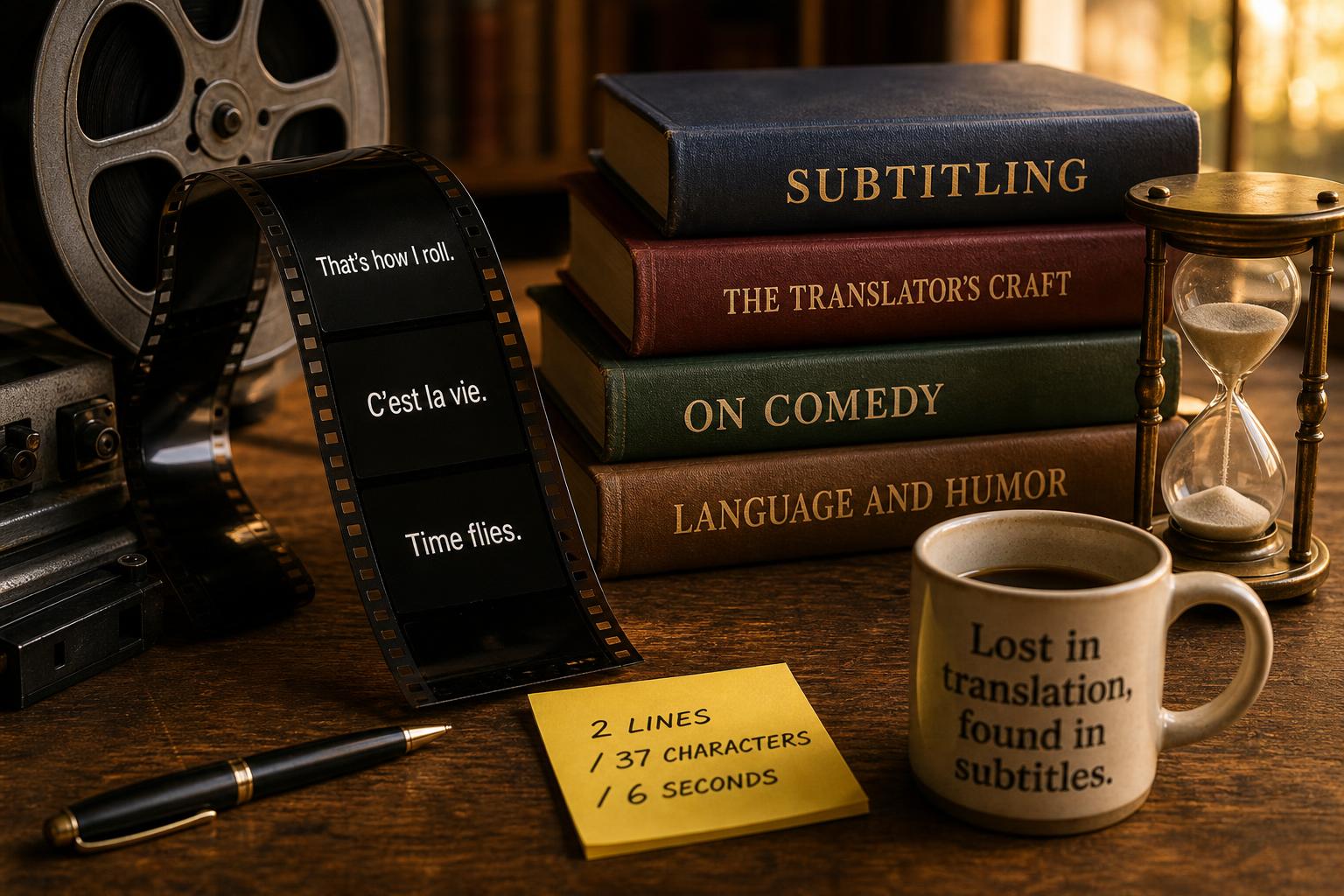
Translating humour is already one of the hardest things in a translator’s job. A pun, a wordplay, a culturally specific reference – these are built so tightly into the language and its culture and ideology that picking them apart and transferring them to another language can feel like solving a puzzle that doesn’t have half the pieces in the target language.
In subtitling, that puzzle comes with a timer and a character limit.
A significant part of why a joke works in a film is often related to how it sounds, how long it takes to land and the specific word choice used by the writer. The subtitler’s job isn’t just to find an equivalent in another language – they have to do it in roughly 42 characters, timed to disappear the moment the scene moves on. Sometimes the solution is elegant, and the audience never suspects a thing. Other times the best possible option is a compromise, and the joke comes across a little softer than it should. And occasionally, no clean solution exists at all.
And this is where we can see the difference between a professional subtitler and a general translator the best. Subtitling is its own discipline – an outstanding command of both target and source languages is only the starting point. What matters is knowing how to work within the constraints without losing what the writer intended, and that comes only with practice and experience.
In bilingual markets such as Belgium, cinema screenings routinely carry both Dutch and French subtitles simultaneously. The Baltics have also long accommodated dual Latvian-Russian subtitles, although that format is becoming increasingly rare. This is not simply a matter of doing the job twice.
A bilingual subtitle file means that every line on screen has to work in two languages at once – fitting within the space available, reading naturally in both, and timed to the same cue. However, the real challenge here is quality control. Reviewing a bilingual subtitle file requires an editor who is equally fluent in both languages and can assess the accuracy, tone, and flow of each simultaneously. A Dutch editor checking only the Dutch, and a French editor checking only the French, is not the same thing – the two tracks interact, and someone needs to see the full picture. And then there is always the question of the translators’ preferences and beliefs, so the reviewer not only plays the role of a quality controller but sometimes also a mediator between two conflicting opinions.
It is a niche within a niche, and one that requires a very specific kind of expertise.

Here is something most people don’t know: the translator rarely has anything to do with the title.
Film titles are mainly the duty of the distributor’s marketing team in each territory – people whose priority is selling the film, not preserving the original intent. The results can be surprising. Here are some of our favourite examples:
In these examples you can see where the idea is coming from – even if they sometimes verge on spoilers. Other times the logic is harder to follow. It is not unheard of for a distributor to request a title that has little to do with the original. So, a film called “Refuge” might become “Pagātnes rēgi” (“Ghosts of the Past”) in the Latvian market, for instance. The film is the same. The story is the same. But the title is ultimately a marketing decision, not a translation one – and in a competitive market where getting audiences into cinemas is no small feat, those decisions are driven by entirely different priorities than linguistic accuracy.
As a subtitler, you get the brief, you deliver the title you were asked for, and you move on. Whether you agree with the decision is beside the point. Although sometimes you might want to add a note that you had nothing to do with it.
Subtitling is one of the disciplines whose complexity goes unnoticed by the audiences – and that is a sign it is working. Behind every line on the screen there is a long list of technical requirements, linguistic precision, cultural adaptation, and creative decision-making. The audience follows the story, laughs at the jokes, taking the text at the bottom of the screen as a natural part of the experience, never giving it a second thought.
And when that happens, it means that someone has done their job well.
At LMI, we work with experienced subtitlers who know the rulebook inside out – and know when to use their judgment. If you need subtitling services for your film, series or any other audiovisual content, get in touch with us:
Email: [email protected]
Phone: +371 26011192

Copy. Delete. Translate. Paste it back. Is that still how your translation process works? We sat down with Kristīne Špate, Chair of the Board at LMI Translations, to talk about a common but risky habit in corporate translation workflows, and how the new ISO 18587 certification helps eliminate it.

LMI Translations has been included in the highest “A” rating group by Latvia’s State Revenue Service for 2025, confirming trustworthy, responsible business.